
The Revd Thomas Appleford Woolls: Fifty Years as Vicar of Fareham
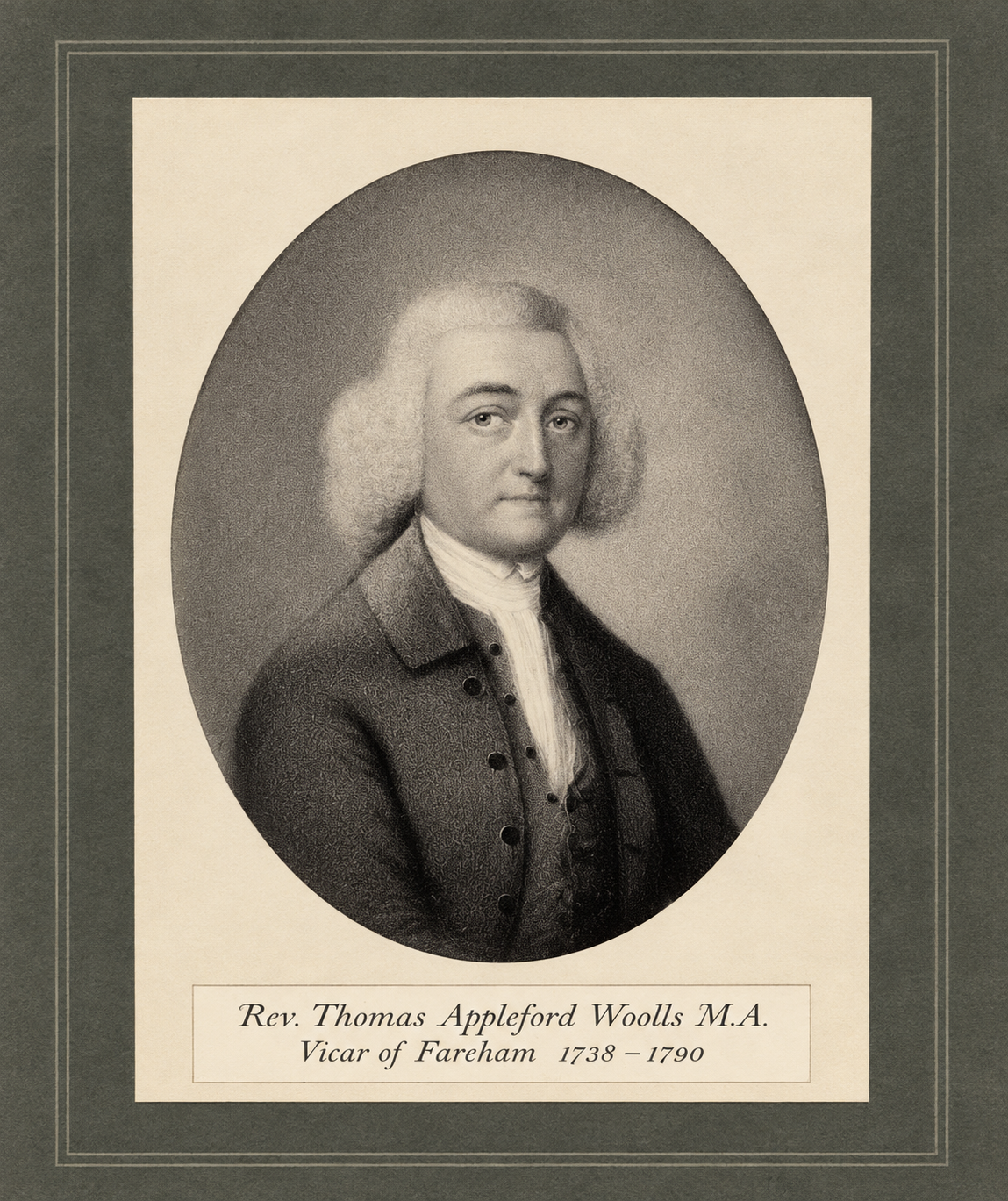
The Revd Thomas Appleford Woolls served as Vicar of Fareham for around fifty years, from 1738 until his death in 1789 or the beginning of 1790. His was one of the longest ministries in the history of St Peter & St Paul.
Woolls came from Hampshire. Oxford records describe him as the son of John Woolls of Alresford. He matriculated at Pembroke College, Oxford, in March 1733 at the age of eighteen, graduated BA in 1736 and proceeded MA in 1739. The same record describes him as Vicar of Fareham for fifty years.
His long incumbency means that he ministered through an extraordinary period of British history. When he arrived in Fareham, George II was king. By the end of his ministry George III had been on the throne for nearly thirty years. Britain had fought major wars in Europe, North America, India and at sea, had gained and then lost colonies, and had emerged as one of the world’s dominant naval powers.
For Fareham, the growth of the Royal Navy was especially significant. Portsmouth Dockyard expanded throughout the eighteenth century, drawing sailors, craftsmen, merchants and military families into the district. Fareham’s position beside Portsmouth Harbour meant that naval activity, troop movements, wartime mobilisation and overseas news would have formed part of everyday life.
Woolls also served during the Seven Years’ War of 1756–63, when Britain fought France on several continents. British victories in Canada and India transformed the country’s overseas position, while the Royal Navy became increasingly central to national power.
Then came the American War of Independence. From 1775 to 1783 Britain fought to retain its North American colonies, while France, Spain and the Dutch Republic entered the conflict against Britain. A parish so close to Portsmouth would have felt the consequences through naval mobilisation, returning ships, wounded men, prisoners, merchants and families waiting for news.
Church life was changing too. The eighteenth-century Church of England could often appear settled and institutional, but the Evangelical Revival was beginning to reshape British Christianity. John Wesley and George Whitefield were preaching to large crowds across the country, while new emphasis was being placed on conversion, personal faith and holiness. Woolls therefore served at a time when Anglican life was beginning to change beneath the surface.
His family became part of Fareham’s continuing clerical story. His son John Aubrey Woolls studied at Pembroke College, Oxford, and succeeded him as Vicar of Fareham in 1790, remaining in the parish until his death in 1811.
Another son, also named Thomas Appleford Woolls, studied at Pembroke College and later became associated with local civic and agricultural life. A contemporary obituary described him as captain of the Portsmouth troop of yeomanry cavalry and a former president of the local Agricultural Society.
Thomas Appleford Woolls therefore did more than serve a long incumbency. For roughly half a century he stood at the centre of Fareham parish life while Britain changed from an eighteenth-century kingdom into a global naval and commercial power.
Generations of Fareham families would have known him as their vicar. Children he baptised early in his ministry could have returned decades later with grandchildren of their own. Few clergy connected with St Peter & St Paul can have shaped the parish across such a long span of time.
