
Revd William Harrison: Thirty-Five Years of Faithful Ministry in Fareham
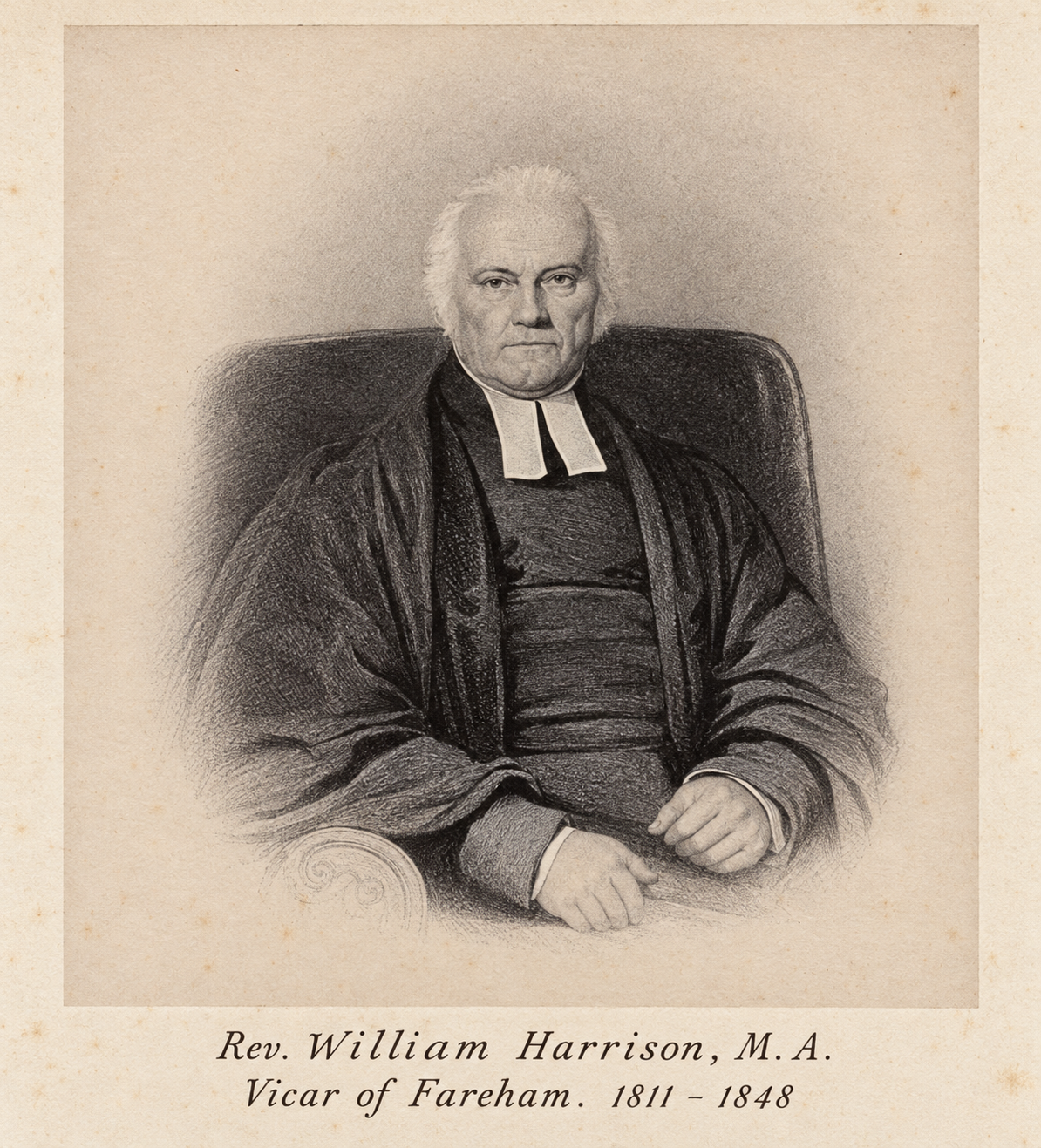
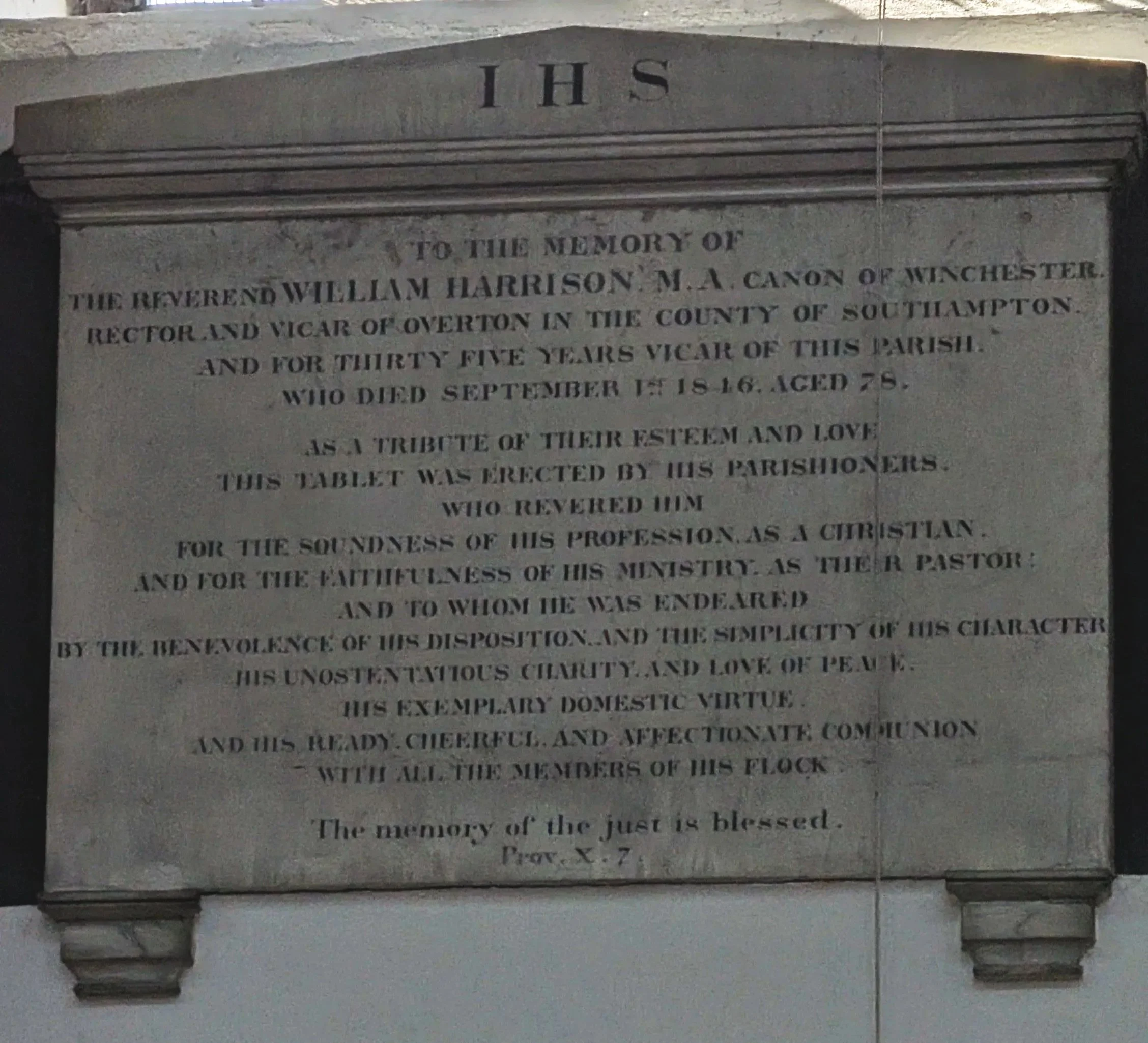
High on the wall of St Peter & St Paul’s Church is a memorial to a man whose service was quieter than the naval battles and military campaigns remembered elsewhere in the building, but whose influence may have been felt much more directly by generations of people in Fareham.
His name was the Revd William Harrison, and for thirty-five years he served as Vicar of this parish.
Harrison was born in Surrey and educated at Oriel College, Oxford, where he matriculated in 1786 at the age of eighteen. He graduated BA in 1790 and later took his MA. His ministry eventually brought him to Hampshire. He became Vicar of Overton in 1796 and, in 1811, Vicar of Fareham. Later he also became a prebendary, or canon, of Winchester Cathedral. He remained Vicar of Fareham until his death on 1 September 1846. Wikisource
Thirty-five years is a long time to serve one parish. Harrison arrived while George III was still king. He ministered through the Regency, the reigns of George IV and William IV, and into the early years of Queen Victoria. Children he baptised at the beginning of his ministry could have become parents and even grandparents before he died.
Yet the most revealing thing about Harrison is found on the memorial itself.
It was erected by his parishioners.
They could have simply recorded his offices and qualifications. Instead, they chose to describe the kind of pastor they believed he had been. They remembered his “faithfulness of his ministry as their pastor”, his benevolence, his simplicity of character, his “unostentatious charity”, his love of peace, and his “ready, cheerful, and affectionate communion with all the members of his flock”.
Those are remarkable words to have written about a minister after thirty-five years.
A new clergyman can make a strong impression. Thirty-five years is different. Over that length of time people see a person through ordinary Sundays, difficult meetings, funerals, family tragedies, disagreements, illness and change. Harrison’s memorial suggests that, after decades of seeing him at close quarters, his parishioners remembered a man whose Christian faith could be recognised in the way he treated people.
His ministry also reached beyond Fareham. In 1820 he became a prebendary of Winchester Cathedral, where another memorial was placed to him after his death. His Oxford record describes him eventually serving as treasurer there as well. Yet Fareham remained the parish in which he spent the greater part of his ministry. Wikisource
There is also a more painful chapter to the Harrison family story preserved elsewhere in our church.
William Harrison was the father of Major Gustavus Nicolls Harrison of the 63rd Regiment, whose own memorial hangs on another wall at St Peter & St Paul’s. Gustavus followed a very different calling from his father. He became a soldier, served in the Crimean War, was wounded at the Battle of Inkerman and was eventually killed while proceeding to duty in the trenches before Sevastopol in July 1855.
Father and son are therefore remembered within the same church: one for decades of pastoral service in Fareham, the other for military service which ended thousands of miles away in Crimea.
William Harrison never lived to see his son’s death. He died nine years earlier, aged 78.
His own memorial ends with words from Proverbs 10:7:
“The memory of the just is blessed.”
For a Christian minister, perhaps there are few better epitaphs.
Harrison held significant positions. He was Oxford educated, a canon of Winchester, a rector and a vicar. Yet the people who placed this stone on the wall wanted future generations to remember something more personal: that their pastor was faithful, charitable, peaceable, cheerful and affectionate towards his people.
There is something deeply encouraging about that kind of life. Most Christian ministry is made up of ordinary faithfulness repeated over many years: preaching another sermon, visiting another family, baptising another child, burying another parishioner, praying with someone who is suffering and remaining with a community through seasons of change.
William Harrison did that in Fareham for thirty-five years.
Nearly two centuries later, the parishioners who erected his memorial have also disappeared from living memory. Yet the testimony they left behind still speaks.
The Revd William Harrison: thirty-five years serving one parish, remembered by his people for faithful ministry, quiet charity and love for his flock.
