
Lieutenant Douglas Lawson: The Engineer Who Helped Build a City
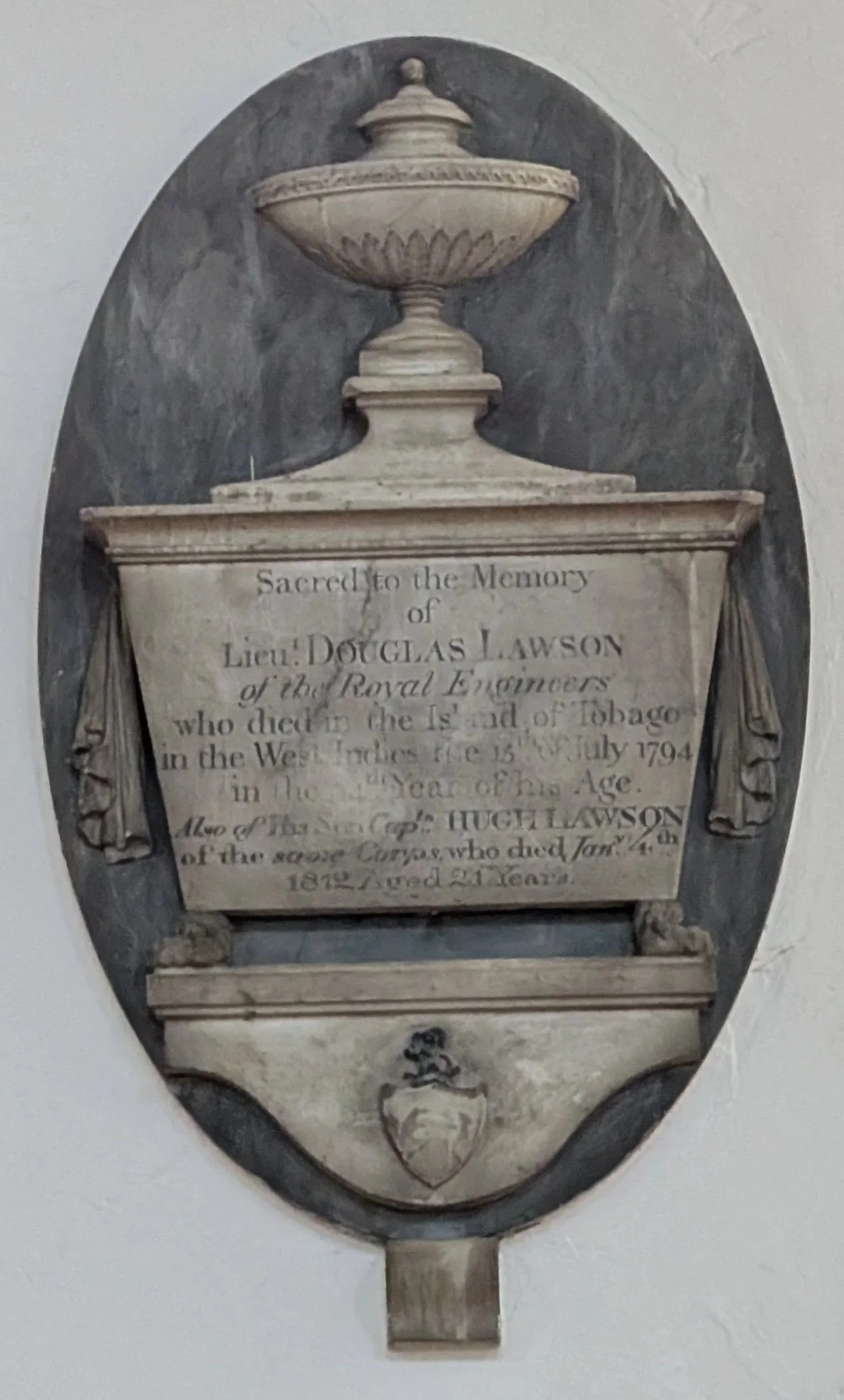
High on the wall of St Peter & St Paul’s Church is an eighteenth-century memorial to Lieutenant Douglas Lawson of the Royal Engineers. The inscription tells us that he died on the island of Tobago in the West Indies in 1794. Behind those few words lies a remarkable career which took him from the aftermath of the American Revolution to the construction of one of the fastest-growing settlements in North America, and finally into a dangerous military campaign in the Caribbean.
Lawson belonged to the Royal Engineers, a profession which demanded far more than the ability to fight. Military engineers surveyed unfamiliar country, designed fortifications, laid out roads and towns, constructed wharves and barracks, and created the infrastructure that allowed armies and settlements to function. Lawson's surviving record shows him being trusted with precisely this sort of responsibility.
In 1783, the American War of Independence was coming to an end. Thousands of people who had remained loyal to Britain were leaving the newly independent United States. Many gathered in New York waiting to be evacuated to other parts of the British Empire. One of the principal destinations was Port Roseway in Nova Scotia, soon renamed Shelburne.
Lawson was sent there at a remarkable moment in its history.
A contemporary account records that Lieutenant Douglas Lawson of the Royal Engineers and Ensign William Lambton arrived with carefully prepared instructions from Sir Guy Carleton. Lawson was expected to examine the harbour and help determine where troops, supplies and military stores should be landed. He was also instructed to make provision for a military post, a town, wharves, barracks and other public buildings. In effect, he was being asked to help turn an undeveloped harbour into a functioning settlement. DalSpace
The scale of what followed was extraordinary. The first Loyalist refugees arrived in May 1783. Within a year, Shelburne had grown to around 10,000 inhabitants. Parks Canada records that the settlement grew so rapidly that it became one of the largest communities in British North America. Parks Canada
Imagine the practical challenge. Thousands of people were arriving by ship, many having lost homes, businesses and possessions during the Revolution. They needed somewhere to land, somewhere to live, roads to move along, buildings for administration and defence, places to store provisions and a harbour that could operate safely.
Lawson's job was to help create order out of that uncertainty.
His written instructions are revealing. He was to think about where the town should stand, where the military position could best defend the harbour, where wharves should be constructed and where land should be reserved for the public buildings of what officials hoped would become a “great and permanent establishment”. Nova Scotia Archives
Shelburne's story was complicated. The enormous early population proved unsustainable and many settlers later moved elsewhere. The Loyalist migration also included Black Loyalists who had been promised freedom for supporting the British during the Revolution. Around 1,200 established nearby Birchtown, while racial discrimination, unequal land allocation and slavery remained part of the society being created. Canadian Museum of History
For Lawson himself, however, Shelburne demonstrates the extraordinary responsibilities that could be placed upon a young Royal Engineer. He was working at the intersection of surveying, construction, military defence and the movement of thousands of people. Some of the streets and structures he helped plan belonged to a settlement created almost overnight.
His service then carried him into another part of the British world.
By 1793 Britain was again at war with France. A major expedition was prepared for the West Indies under General Sir Charles Grey and Admiral Sir John Jervis. The surviving account of the expedition lists Douglas Lawson among a small group of Royal Engineer officers selected for the campaign. He was serving as a first lieutenant under Colonel Elias Durnford, the expedition's chief engineer. Arc Codex
The Royal Engineers had an essential and dangerous role. They had to survey enemy positions, construct batteries, strengthen captured fortifications and prepare defences. A later account connects Lawson and Lieutenant Richard Dowse with the construction of fortifications around Road Harbour in the British Virgin Islands, intended to protect an important anchorage used by British shipping. The V Magazine
The campaign was brutal. British forces fought across islands including Martinique, St Lucia and Guadeloupe. Engineers worked close to the fighting, sometimes constructing batteries during the night so that artillery could open fire the following morning. Reading Rooms
Yet battle was only one of the dangers.
Disease devastated British forces in the Caribbean. A history of the corps records that by the end of 1794 65 non-commissioned officers and men from the engineering force had died, along with several of its officers. Among those named are Colonel Durnford, Captain Chilcot and Lieutenants Dowse and Lawson. The surviving effective strength had been reduced dramatically. Arc Codex
Lawson's memorial tells us where his own journey ended. He died on Tobago in July 1794, far from England and roughly eleven years after he had helped receive the Loyalist settlers in Nova Scotia.
There is something particularly compelling about the life of a Royal Engineer. Soldiers are often remembered for the battles they fought. Engineers frequently left a quieter kind of legacy. Their work remained behind them: roads, harbours, defences, buildings and settlements which continued to be used after the men who designed them had gone.
Douglas Lawson's surviving story stretches across an extraordinary geographical distance. In Nova Scotia he helped prepare a new settlement for thousands of displaced people after the American Revolution. In the Caribbean he was entrusted with military engineering during another major war. He served until that service carried him thousands of miles from home and ultimately cost him his life.
More than two centuries later, his memorial remains on the wall of St Peter & St Paul’s in Fareham.
It is easy to see only a name carved into stone. Yet behind that name was an engineer entrusted with difficult problems in difficult places: survey the ground, make a plan, build what is needed, protect the people who will depend upon it, and keep going when the conditions are hard.
That is a form of service worth remembering.
Lieutenant Douglas Lawson, Royal Engineers: from the building of Shelburne in Nova Scotia to service in the West Indies, one of the remarkable lives remembered within the walls of St Peter & St Paul’s.
