
Captain John Richard Lumley RN: The Officer Who Lost an Arm in Battle and Continued to Command
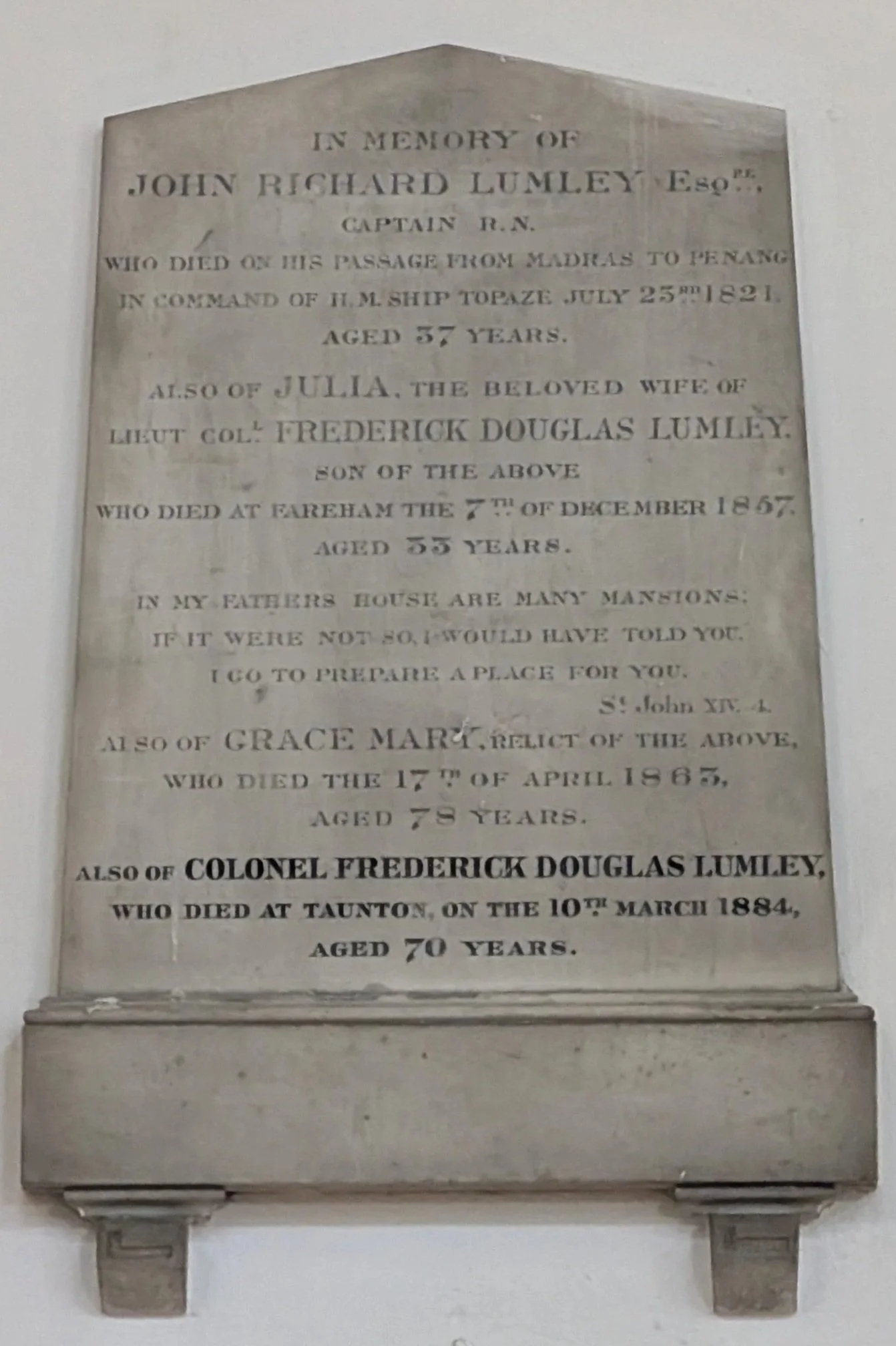
On the wall of St Peter & St Paul’s Church is a memorial to Captain John Richard Lumley RN, who died in 1821 at the age of just 37. The inscription tells us that he died while commanding HMS Topaze on the voyage from Madras to Penang. What it does not tell us is that Lumley had already lived an extraordinary naval life. He had fought under Nelson, lost an arm in a night attack on the French coast, commanded warships during the War of 1812, and eventually led a British naval expedition in the Red Sea.
Lumley became a lieutenant in the Royal Navy in 1801, during the Napoleonic Wars. Only three years later he found himself serving with Lord Nelson’s Mediterranean fleet, then maintaining the blockade of the French naval base at Toulon. On the night of 11 July 1804, Lumley was one of the officers leading ten small boats from the frigates Narcissus, Seahorse and Maidstone into an attack at Lavandou on the French coast. Wikimedia Commons
It was an extraordinarily dangerous operation. The British sailors had left the protection of their ships and were approaching in open boats. Waiting for them were armed French vessels and troops on shore. At around ten o’clock at night the British boats went in, and the French opened a tremendous fire.
Lumley kept going.
The sailors reached the enemy vessels, boarded them and destroyed most of them, but they paid heavily for it. Four British men were killed and twenty-three wounded. Among the wounded was John Richard Lumley. His injury was devastating: he lost an arm. Wikipedia
News of the action reached Nelson. His response survives in his correspondence, and Lumley was named personally. Nelson wrote that the example given by “Lieutenants Parker, Lumley, and Moore” had encouraged the officers and men serving beneath them. Then came words that must have meant something particularly personal to a young officer who had just lost an arm:
“Wounds must be expected in fighting the Enemy. They are marks of honour.”
Nelson had seen something important in Lumley. Leadership in battle meant going first. The courage of the men depended, at least in part, upon seeing courage in their officers. Wikimedia Commons
For Lumley, losing an arm at around twenty years of age could easily have brought his active naval career to an end. It did not.
The following January he was promoted commander. By September 1808 he had reached the rank of post-captain, one of the important milestones in a Royal Navy officer’s career. Over the following years he commanded a succession of ships, including HMS Paulina, Hind, Crocodile, Topaze, Narcissus and Pomone. Three Decks
His career then carried him across the Atlantic.
During the War of 1812 between Britain and the United States, Lumley commanded the 32-gun frigate HMS Narcissus. On 17 January 1813, Narcissus captured the American armed brig Viper. Later that year, boats from Lumley’s ship attacked the American revenue cutter Surveyor in the York River in Chesapeake Bay. The Americans resisted fiercely before the vessel was taken. Wikimedia Commons
There is something remarkable about imagining Lumley by this stage of his career. Less than a decade earlier he had been a young lieutenant lying wounded after losing an arm. He was now captain of a Royal Navy frigate conducting operations thousands of miles from home.
His final command would take him further still.
In 1818 Lumley commissioned another HMS Topaze, a 38-gun frigate, and sailed for the East Indies. Naval service in that part of the world brought dangers quite different from European warfare. In 1819 Topaze arrived at Mauritius carrying a serious outbreak of disease among her crew. By the end of the following year Lumley and his ship had been ordered to the Red Sea as part of a British and East India Company expedition to Mocha, in present-day Yemen. Wikipedia
Negotiations over British grievances had failed, and Lumley commanded the naval force sent against the town. From December 1820 into January 1821, the operation involved bombardments, attacks on fortified positions and further negotiations. Men were killed and wounded on both sides. Eventually the authorities at Mocha accepted the British terms. Three Decks
It had been seventeen years since the night attack at Lavandou. The young lieutenant who had followed others into battle under Nelson had become the captain commanding an expedition himself.
He would not live much longer.
On 23 July 1821, while still captain of HMS Topaze, John Richard Lumley died as the ship approached Penang, then known as Prince of Wales Island. He was only 37. He was buried at Penang, thousands of miles from Fareham. The Royal Navy’s records of post-captains confirm his death in July 1821 while commanding Topaze. Navy Records Society
Yet his name came home.
The tablet in St Peter & St Paul’s remembers him alongside his family. His widow, Grace Mary, lived for more than forty years after his death, and their son, Frederick Douglas Lumley, later became a lieutenant-colonel. The memorial therefore became more than the record of an officer who died abroad. It became a place where a family could remember someone whose grave lay on the other side of the world.
Lumley’s story is especially striking because his greatest act of courage came early in life. At around twenty years old he went into battle, was terribly wounded and lost an arm. He then spent another seventeen years serving at sea, rose to the rank of captain and commanded Royal Navy warships across Europe, North America and Asia.
There is something worth remembering in that kind of perseverance. Courage is sometimes one dramatic moment. At other times it is what happens afterwards: adjusting to what has been lost, accepting responsibility again, and continuing to serve.
Nelson remembered John Richard Lumley as one of the officers whose example encouraged the men around him. More than two centuries later, his memorial in Fareham still allows that example to be remembered.
Captain John Richard Lumley RN: wounded under Nelson, an arm lost in battle, yet still rising to command ships across the world.
