
Richard Collins: The Hampshire Artist Who Painted King George III
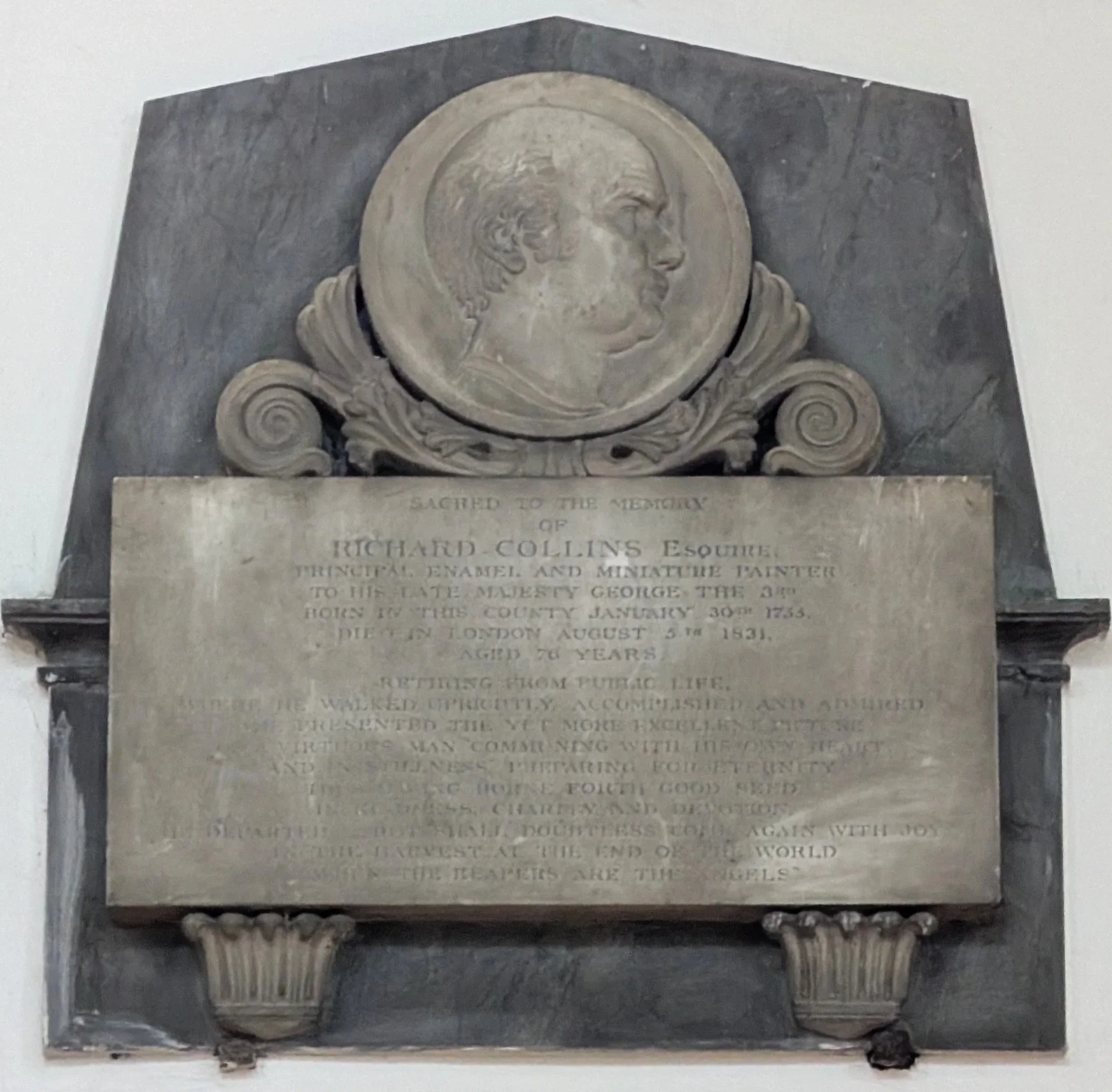
Among the memorials inside St Peter & St Paul’s Church is one that looks rather different from many of the military and naval monuments around it. Above its inscription is the carved profile of a man. His name was Richard Collins, and during his lifetime his skill took him from Hampshire into the highest circles of Georgian Britain.
One small correction is worth making at the outset. Collins was closely connected with Hampshire and is commemorated here in Fareham, but surviving biographies place his birth in Gosport on 30 January 1755, rather than Fareham itself. His memorial carefully says that he was “born in this county”. Wikipedia
Collins discovered his calling in an art form that demanded extraordinary patience. He specialised in portrait miniatures and enamel painting. Before photography, a miniature portrait could allow someone to carry the likeness of a husband, wife, child, friend or monarch with them. These were intimate objects, sometimes only a few centimetres across, and creating a convincing human face at that scale required remarkable control.
Collins trained under Jeremiah Meyer, himself an important royal miniature painter and one of the original members of the Royal Academy. Collins then began exhibiting his own work at the Royal Academy in 1777. He entered a highly competitive world in which wealthy families, aristocrats and members of the royal household commissioned portraits from the best artists of the age. Project Gutenberg
His skill eventually brought him to the attention of the King.
In 1789, Richard Collins was appointed a painter in enamel to King George III. Contemporary and later records describe him as one of the leading miniature painters serving the royal court. His sitters included members of the Royal Family and some of the most prominent people of Georgian society. Nelson Atkins
One surviving miniature of George III gives a sense of the precision involved. The portrait, painted around 1790, measures only about 1.9 centimetres across. Yet within that tiny space Collins had to capture the King’s face, clothing, expression and status. Wikimedia Commons
For many people today, George III is remembered through the American Revolution or through his later illness. To Collins, however, he was also a living person who had to sit before an artist and be observed closely enough for his likeness to be preserved. Collins was trusted to create images through which the King and his family would be recognised.
His work reached well beyond royal portraiture. The National Portrait Gallery attributes portraits to him and records a portrait of George III derived from his work, while the Metropolitan Museum of Art today holds his miniature of George Howard, Lord Morpeth. His paintings have therefore travelled far beyond the Hampshire world in which he was born and now survive in major international collections. National Portrait Gallery
There is something particularly striking about Collins's story because his greatness was expressed through small things.
He did not build enormous monuments or command armies. His life's work could sometimes be held in the palm of a hand. His reputation came from learning to do a difficult thing exceptionally well: observing carefully, developing his skill and producing work precise enough to be trusted by a king.
After many successful years in London, Collins left the capital in 1811 and retired to Pershore in Worcestershire, resigning his royal appointment. Yet art continued to draw him. Around 1828 he returned to London, where he lived near Regent’s Park until his death on 5 August 1831, aged 76. Wikipedia
His memorial in St Peter & St Paul’s describes him proudly as:
“Principal Enamel and Miniature Painter to His Late Majesty George the 3rd.”
Nearly two centuries later, the monument still preserves his face above those words.
Richard Collins's story is a reminder that remarkable lives are built in many different ways. Some of the people remembered on our walls crossed oceans or fought in battles. Collins mastered a craft. Through years of patient work, a Hampshire-born artist became trusted to paint the King himself.
And the extraordinary thing is that some of those tiny portraits still survive today.
His memorial remains here in Fareham, while his work can now be found in collections across the world. It is another reminder that behind the names carved into the walls of St Peter & St Paul’s are people whose lives reached much further than we might imagine.
If you know more about Richard Collins, his family, or why his memorial was placed here at St Peter & St Paul’s, we would be very pleased to hear from you.

