
Captain John Miller Adye: The Fareham Officer Who Fought with Nelson and Chased Napoleon
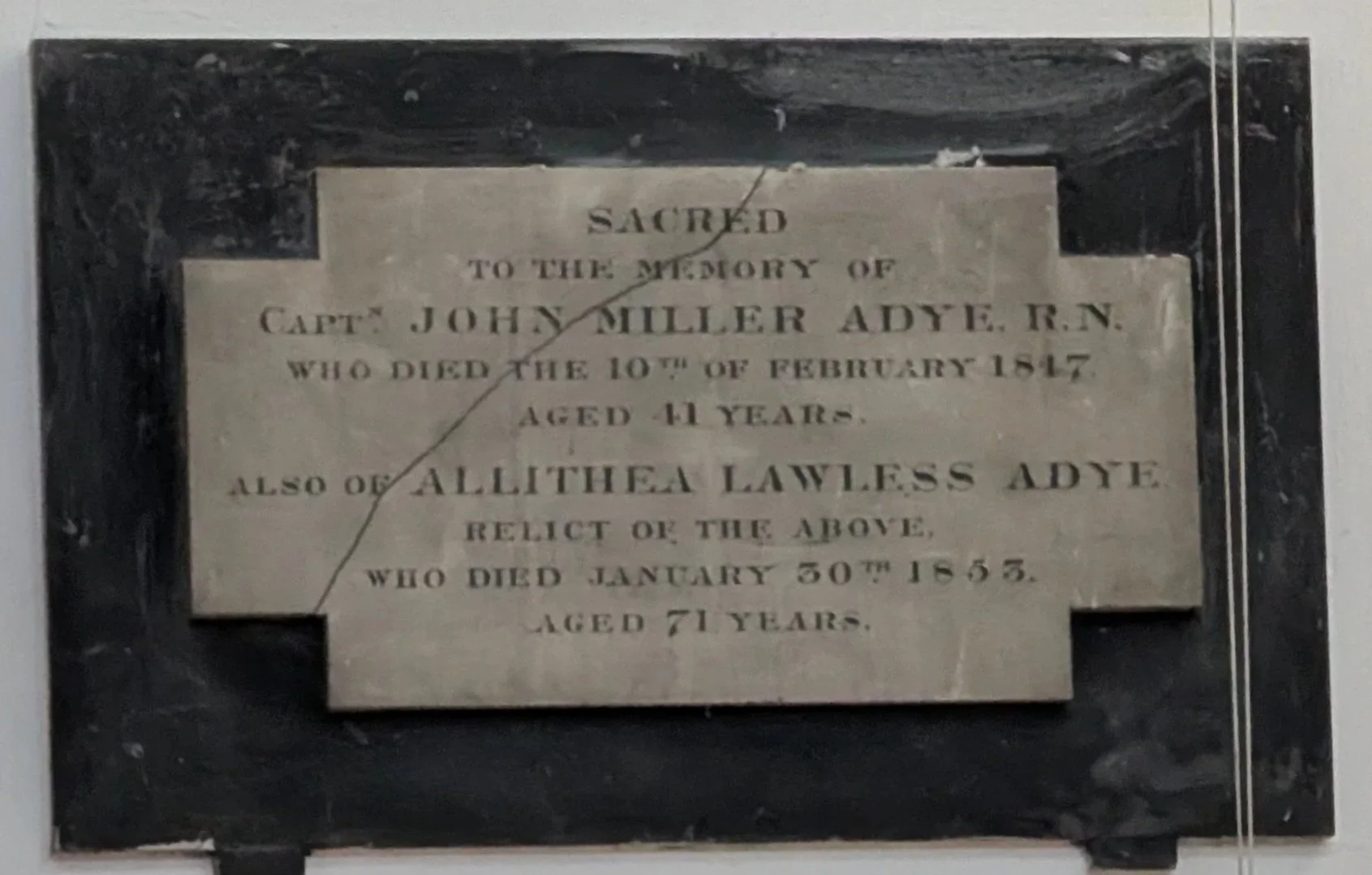
Among the memorials on the walls of St Peter & St Paul’s Church is a relatively simple stone tablet dedicated to Captain John Miller Adye RN, who died on 10 February 1817, aged only 41. There is little on the monument itself to suggest just how extraordinary his naval career had been. Adye had fought beside Nelson at one of Britain’s greatest naval victories, had been wounded in battle, and years later found himself caught up in the dramatic escape of Napoleon from exile.
His story begins during Britain’s long war with Revolutionary France. By 1797 Adye had become a lieutenant in the Royal Navy, and the following year he was serving aboard HMS Vanguard, the flagship of Rear-Admiral Horatio Nelson. In the summer of 1798 Nelson was hunting a French fleet which had carried Napoleon Bonaparte and his army towards Egypt. On 1 August, the British finally found the French warships anchored in Aboukir Bay. Nelson decided to attack immediately. Three Decks
What followed became the Battle of the Nile, one of the defining victories of Nelson’s career. The fighting continued into the night, illuminated dramatically when the huge French flagship L’Orient caught fire and exploded. Vanguard was in the heart of the battle. Nelson himself was struck in the head and briefly believed that he was dying. John Miller Adye was also wounded. Contemporary records of the battle list “J. Adye” among the wounded lieutenants of Vanguard. Naval History and Heritage Command
There is an extraordinary visual connection to Adye’s story in the collections of Royal Museums Greenwich. A later painting of Nelson on the quarterdeck of Vanguard during the Battle of the Nile depicts Lieutenant John Adye standing between Nelson and Captain Edward Berry as the burning L’Orient explodes in the distance. The picture is an imagined reconstruction rather than a literal eyewitness record, but it shows how closely Adye was associated with the officers at the centre of the battle. Royal Museums Greenwich
Adye survived his wound and continued his naval career. He became a commander in 1806 and eventually took command of the 18-gun sloop HMS Partridge. By 1815 Europe appeared finally to be entering a period of peace. Napoleon had been defeated and exiled to the small Mediterranean island of Elba. The British representative there was Sir Neil Campbell, whose job included watching Napoleon and reporting on his activities.
Then came one of those moments when history suddenly turns.
In February 1815, Campbell travelled from Elba to the Italian mainland aboard Adye’s Partridge. While Campbell was away, rumours began circulating that Napoleon intended to escape. Adye actually returned to Elba on 24 February to investigate. According to accounts of Napoleon’s time on the island, he saw nothing obviously suspicious and sailed away again. Yet preparations for Napoleon’s departure were already under way. Napoleon & Empire
Two nights later, Napoleon escaped.
Campbell hurried aboard Partridge and attempted to return to Elba, but light winds slowed the ship. When Adye finally reached the island on the morning of 28 February, Napoleon had already gone. Partridge then sailed in pursuit towards the French coast, but nobody knew exactly where Napoleon was heading and Adye was unable to intercept him. Project Gutenberg
Napoleon landed in France and began the extraordinary campaign remembered as the Hundred Days, which would end a few months later at Waterloo.
It is remarkable to think how close Adye had come to two of the most famous figures of his age. As a young lieutenant, he had fought and been wounded aboard Nelson’s flagship at the Nile. Seventeen years later, as commander of his own ship, he was sailing the waters around Elba during Napoleon’s escape and then joined the attempt to find him.
Later in 1815, Adye was promoted to the rank of captain. He would enjoy that rank for only a short time. He died on 10 February 1817, aged 41. His wife, Allithea Lawless Adye, survived him for more than three decades and is commemorated alongside him on the same tablet in St Peter & St Paul’s. Naval records confirm both his promotion in September 1815 and his death in February 1817. Three Decks
There is something striking about the simplicity of his memorial. It gives us his name, his rank and the dates of his life. Yet behind those few carved words stands a man who repeatedly found himself where history was being made.
He stood on the deck of Vanguard while cannon fire tore through the ship at the Battle of the Nile. He was wounded and returned to service. Years later he commanded his own vessel and came within days, and at points only hours, of events which changed the course of Europe.
Most of us will never find ourselves on a battlefield beside Nelson or searching the Mediterranean for Napoleon. Yet Adye’s story still speaks of something recognisable: courage under pressure, perseverance after being wounded, accepting responsibility, and continuing to serve when the outcome could never be guaranteed.
More than two centuries later, his memorial remains quietly fixed to the wall of our church in Fareham. It is easy to walk past. Once you know the story behind the name, it becomes rather harder to do so.
Captain John Miller Adye RN: wounded beside Nelson at the Nile, commander in the waters around Napoleon’s Elba, and one more remarkable life remembered within the walls of St Peter & St Paul’s.
If you have a family connection with John Miller Adye or Allithea Adye, or possess documents, photographs or further information connected with the family, we would love to hear from you.
