
The Revd Walter Scott Dumergue: Thirty-Three Years as Vicar of Victorian Fareham
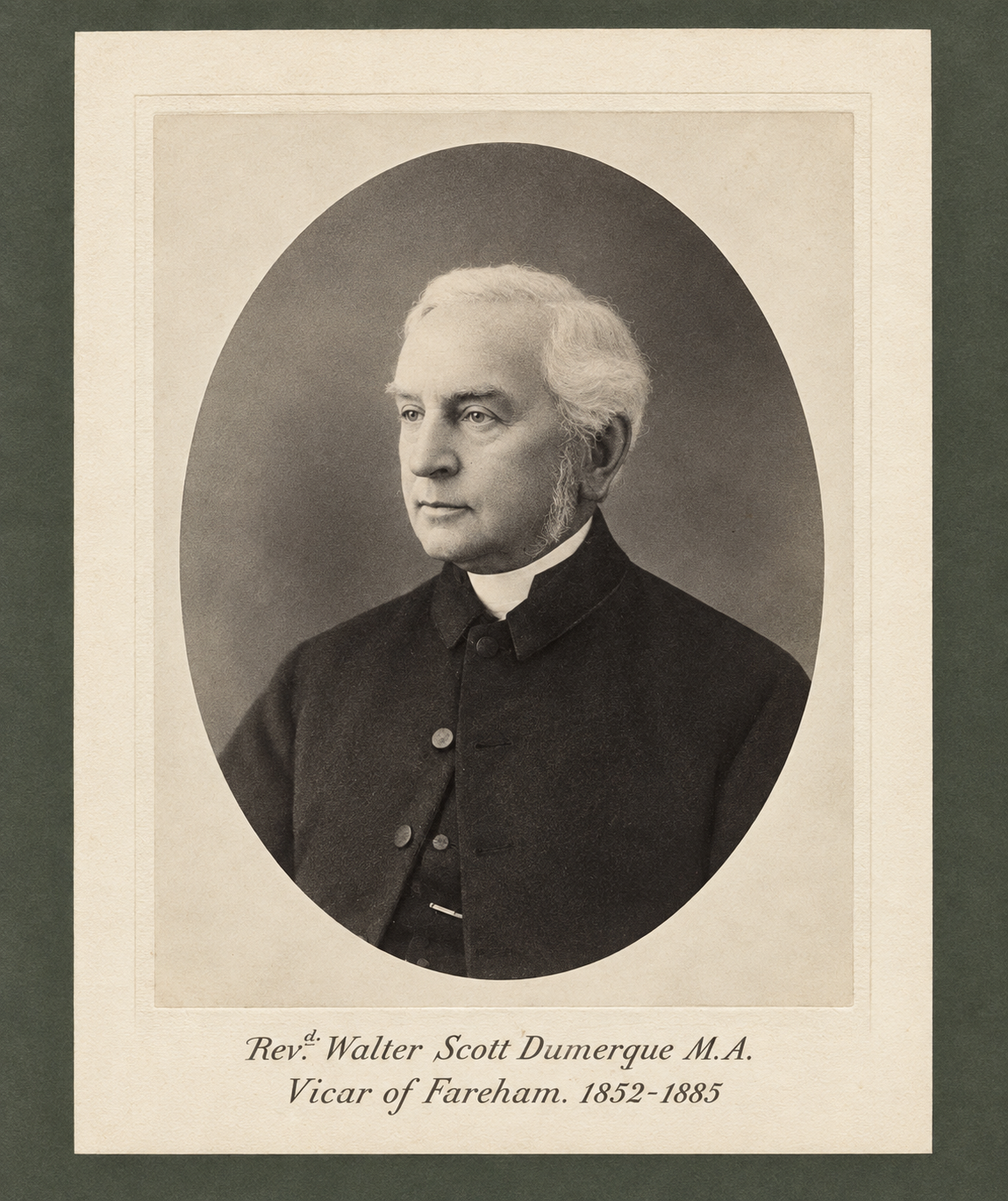
The Revd Walter Scott Dumergue served as Vicar of Fareham from 1852 until his death in 1885, giving St Peter & St Paul more than three decades of continuity during a period when the town and the Church of England were changing rapidly.
Dumergue was born in November 1819 and educated at Corpus Christi College, Cambridge. He was ordained deacon in 1842 and priest the following year. His first recorded ministry was as curate at Wadsley in Yorkshire.
By 1852 he had become Vicar of Fareham. His thirty-three-year incumbency covered much of the Victorian period, from the aftermath of the railway’s arrival in Fareham to an age of expanding industry, population and civic government.
Fareham was becoming increasingly connected with Portsmouth and the wider naval economy. The Royal Navy was itself undergoing a revolution. When Dumergue arrived, wooden sailing warships still formed an important part of the fleet. By the time of his death, ironclads, steam propulsion and heavy modern artillery had transformed naval warfare. Families in Fareham who had known the Navy of Nelson’s generation were now living beside a very different industrial naval power.
The town was also becoming more organised administratively. In 1863 Dumergue was named among the additional commissioners responsible for land tax and other assessments in Hampshire. The same list includes other familiar Fareham names, including Thomas Forbes Kelsall, Joseph O’Brien and John Edward Paddon. It shows how the vicar belonged to the network of clergy, lawyers, landowners and businessmen involved in local civic life.
His ministry coincided with major debates inside the Church of England. The Oxford Movement had encouraged renewed interest in historic liturgy, sacramental theology and church architecture, while evangelical Christianity remained a powerful force. Across Victorian England, parish churches were being restored, new churches built, worship altered and arguments fought over what Anglican identity should look like.
At the same time, the social responsibilities of parish ministry were growing. Victorian clergy were expected to respond to poverty, education, public health and the rapidly changing life of towns. Fareham’s vicar therefore worked in a world where parish ministry increasingly involved schools, charities, civic institutions and the welfare of a growing population as well as Sunday worship.
Dumergue’s family also had an interesting literary connection. The Dumergue family had longstanding links with Sir Walter Scott. Scott corresponded with Charles Dumergue and stayed with the family in London; surviving letters show an affectionate relationship between the households. Scott’s journal even refers to seeing the Dumergue family and particularly “my godson”. Walter Scott Dumergue’s name strongly reflects that connection, although the surviving evidence does not by itself prove that he was the godson Scott mentioned.
Dumergue remained Vicar of Fareham until 1885. A contemporary Cambridge catalogue gives his lifespan as 1819 or 1820 to 1885.
His thirty-three years at St Peter & St Paul placed him at the centre of Fareham during one of the town’s great periods of Victorian change. He began his ministry in a Britain still recognisably shaped by the world of sailing ships and traditional parish life. He died in an age of railways, steam power, expanding towns and an increasingly modern Royal Navy.
For more than a generation, Walter Scott Dumergue was one of the familiar figures at the heart of that changing Fareham community.
