
The Revd Thirlwall Gore Browne: Vicar of Fareham in a Changing Victorian Church
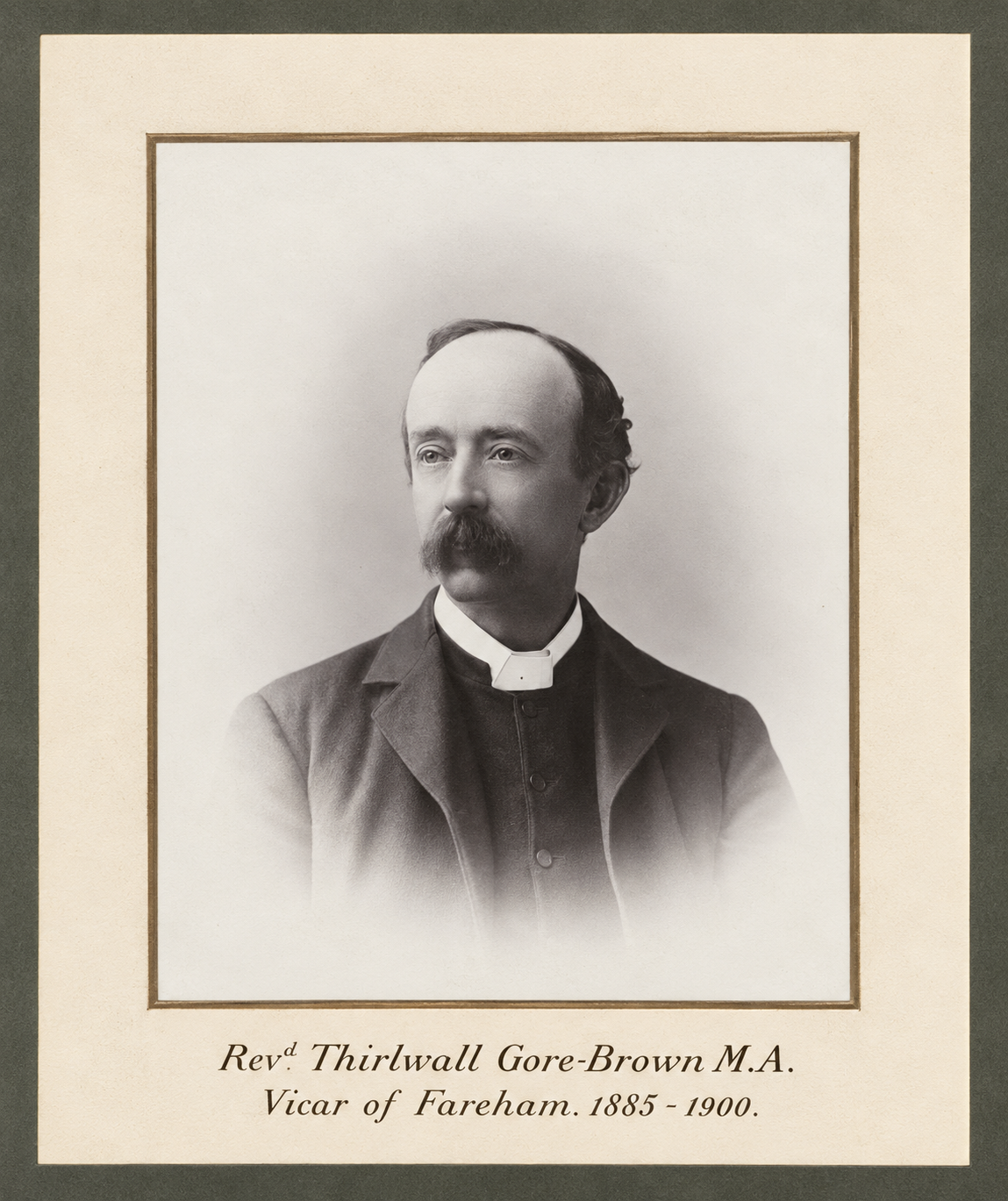
The Revd Thirlwall Gore Browne served as Vicar of Fareham from 1885 to 1900, leading St Peter & St Paul during a period of major change in both the town and the Church of England.
He was born in 1850, the son of Edward Harold Browne, who later became Bishop of Ely and then Bishop of Winchester. Thirlwall was educated at Emmanuel College, Cambridge, and before coming to Fareham served as curate of Cheam Common and then as Vicar of Tilford in Surrey. In 1885 he became Vicar of Fareham, remaining there for fifteen years before moving to Fawley in 1900.
His family background placed him close to the senior life of the Victorian Church of England. His father had been a university professor of divinity before becoming a bishop and was translated to Winchester in 1873. Thirlwall therefore came to Fareham from a family deeply involved in Anglican theology, episcopal leadership and the life of the diocese.
His years in Fareham were also important for the church building itself. In 1888 St Peter & St Paul underwent a major restoration costing more than £6,000. A new chancel was built in the Early English style, while the old medieval chancel was retained as a side chapel. The work was directed by the prominent Victorian church architect Sir Arthur Blomfield.
The church continued to acquire memorials and furnishings during Browne’s incumbency. A stained-glass window commemorating Admiral Carter was installed in 1889, another east window followed in 1891 in memory of two former vicars, and a new reredos was given in 1892. The church people know today was therefore being shaped significantly while Browne was vicar.
The pattern of worship was intensive by modern standards. A late nineteenth-century directory records services at St Peter’s at 8 and 11 in the morning, 3.30 and 6.30 in the afternoon and evening, with additional weekday services and observance of saints’ days. Browne also served as chaplain to the Fareham Union, whose workhouse on Wickham Road could accommodate around 300 people. His ministry therefore extended beyond the parish church into the institutional care of some of the poorest and most vulnerable people in the district.
Fareham itself was changing rapidly. By the end of the century the town had electric street lighting, improved roads, a municipal water supply and increasingly modern local government. Portsmouth and the Royal Navy continued to dominate the wider district, while railways and new housing were drawing Fareham more fully into the Victorian industrial and urban world.
Browne’s own family also became part of Fareham’s story. His son Edward Jasper Gore Browne was born in Fareham in 1886 and later served during the First World War, dying of wounds in France in 1916.
Thirlwall Gore Browne left Fareham in 1900 to become Rector of Fawley, where he remained until 1915.
His fifteen years at St Peter & St Paul belong to an important chapter in the church’s history. Under his ministry the building was substantially restored, worship remained frequent and formal, and the parish continued to serve a town moving rapidly towards the twentieth century.
The church visible today still carries the marks of that period.
